
End Zone Emotions: Navigating Workplace Boundaries Like a Pro

Grab your metaphorical cleats! Let’s explore the topic of emotional agility in the workplace and how it relates to the concept of workplace boundaries. We’ll focus on a recent outburst by Travis Kelce on the football field and how it can help us understand emotional boundaries in professional settings. Together, we’ll dive deep into the playbook for handling workplace emotions like seasoned pros and discuss key takeaways to help you navigate emotional situations while maintaining healthy boundaries.

Takeaway 1: The Passion Play

While raw emotion may fuel the Super Bowl, finesse is key in the workplace. Passion is a powerful driver of innovation when harnessed in a constructive manner that respects workplace boundaries. Instead of charging headlong into challenges, try using assertiveness and empathy to tackle workplace issues while also being mindful of the boundaries of your colleagues and workplace. It’s important to communicate your enthusiasm without crossing the line. Try opening the playbook with phrases like, “I’m excited about this project because…” to convey your passion positively and professionally.

Takeaway 2: Emotional Timeouts

In the heat of the moment, losing sight of emotional regulation and professional boundaries can be easy. Calling a timeout before your emotions get the best of you and cause you to overstep boundaries is essential. Take a breather, regroup, and propose a brief recess in the discussion if necessary. You will not only prevent emotional fumbles or outbursts but also preserve the integrity of the team dynamic and maintain healthy workplace boundaries.

Takeaway 3: Sideline Diplomacy

When faced with emotional tension from a colleague, it’s essential to play defense with diplomacy while also respecting workplace boundaries. Instead of meeting aggression with aggression, intercept the tension with empathy. Try saying, “I understand this is important to you. Let’s work together to find common ground while respecting the boundaries of our colleagues and workplace.” This defensive strategy fosters collaboration and prevents unnecessary workplace friction while maintaining healthy boundaries.

Takeaway 4: Post-Game Reflection

As the dust settles, reflecting on your emotional performance and how it relates to workplace boundaries is important. Consider how your actions impacted team morale and productivity while being mindful of any boundaries you may have overstepped. If your emotions led to penalties, don’t hesitate to issue a workplace apology acknowledging the importance of workplace boundaries. Say, “I recognize that my behavior may have overshadowed our objectives and overstepped some boundaries. Let’s regroup and move forward positively while mindful of our boundaries.” This gesture not only demonstrates accountability but also strengthens team cohesion and reinforces the importance of workplace boundaries.

Emotional intelligence is the key to success in high-stakes business environments, but respect for workplace boundaries must temper it. While Travis Kelce may dominate the football field with his fiery passion, in the realm of professionalism, emotional finesse, and a respect for boundaries wins championships. By staying focused, respecting the boundaries of our colleagues and workplace, and maintaining unwavering integrity, we can elevate the workplace playing field to new heights of excellence.
Quiet Quitting: An Unhealthy Work Trend

Quiet quitting has become a trend, stemming from a viral Tik Tok video, which describes it as “not outright quitting your job, but quitting the idea of going above and beyond.” The quest for work-life balance is led mainly by Millenials and Gen Z, who will make up just over 30% of the workforce by 2030. The question is, is this a template for success or stress?

1) Examples of “quiet quitting”

*Saying no to extra tasks outside of your job description.

  • Not volunteering for work-related events
  • Logging off at 5 pm and leaving unfinished tasks until the following day, rather than working after-hours.
  • Avoid answering calls and emails from your boss or clients after hours.
  • Not arriving to work early.
  • Not answering emails or phone calls if you’re sick or on leave
  • Using your email signature to state your working hours clearly

Some of these are healthy, and some are unrealistic. Being able to recognize the difference is the key to your success. The truth is, work is work. There will be an ebb and flow in this quest for the holy grail: “work-life balance.”

Get Free PDF Herewww.AnastasiaTurchetta.com

2) The Stress In Quiet Quitting

Quiet quitting is passive and often a mistaken identity for healthy boundaries. It can dull your personal and professional growth skills, like problem-solving, compromise, connection, communication, teamwork, resilience, feeling valued, or purpose-filled.

When thinking this is a successful template for your future career path, be mindful that this may contribute to physical, emotional, and financial stress.

Finally, it hurts you when your employer feels you have disengaged, placing you at risk of a demotion or getting let go.

3) Better Burnout Solutions

Healthy boundaries are not quiet. Proactively designed for clear & kind communication, they validate your beliefs to others, accompanied by a mutual understanding which has consequences.

Setting healthy boundaries starts with recognizing the added tasks in your workplace that contribute to burnout. Hint, sometimes the culprit may be found within your personal life too.

Think of a stop light, red, yellow, and green. List each area where you feel a lack of connection or sense of purpose with the organization’s core message. Being overlooked for a promotion, working in a toxic environment, or an environment deficient in diversity or inclusion are examples.

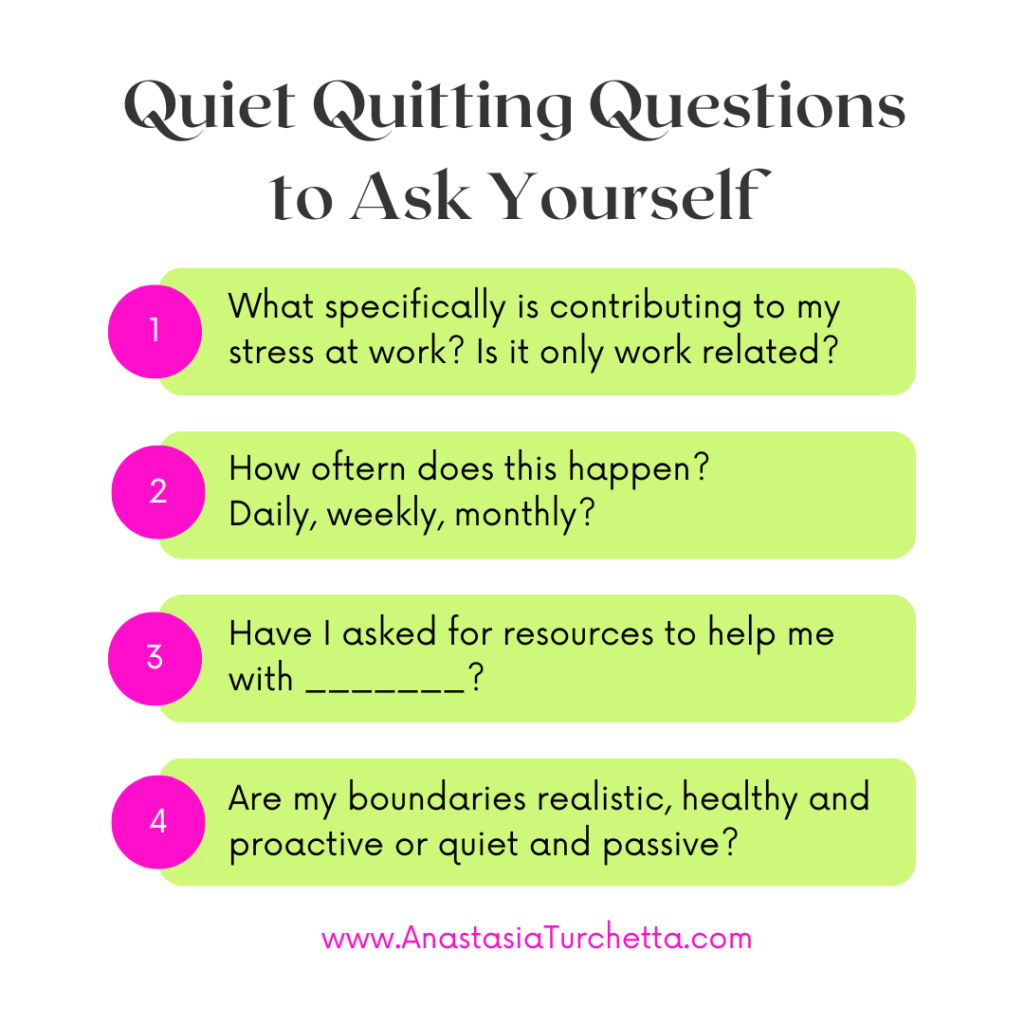
Now, note the following: How often does it happen? Daily, weekly, monthly?

Then ask yourself if you have clearly and kindly communicated your boundaries in three areas: Time, staying late or answering emails after hours; Emotions, do you feel unappreciated, overlooked, or frustrated; Energy, do you have resources to recharge offered to you?

Pay attention to the areas you would mark as red or yellow. Like a stop light, red equals deal breakers; yellow is a flexible zone, and green is a go!

Focus on the yellow. Yellow selections hold promise. It is your opportunity to ask for help with your time, emotions, and energy. Share why you feel burned out and seek resources to help you. For example, mindfulness apps like Headspace have a fee. Are you going through a tough time emotionally? Ask for resources that will be helpful, from grief counseling to daycare, caregiving for aging parents, divorce, financial counseling, etc. Every situation can promote disconnection, stress, anger, sadness, and frustration in your workplace. Every situation is an opportunity to improve.

The green selections are where you are at your best. You are purpose-driven and filled. You are setting yourself up for advancements and, yes, more money! You are in a space to give extra in your workplace without settling for getting by. The goal is to transform your yellow to green and go, go, go in the right direction.

Work-life balance is an illusion. The times in your life when everything is perfectly balanced will be very few. Aim for work-life wellness. Setting and communicating healthy boundaries will be your compass. You know you’ve reached that destination when your time is respected. Emotionally, you feel valued, connected, and purpose-filled, and you have access to the resources to recharge your energy.

Take What You Learn & Make A Difference With It

Anastasia