

Top 5 Boundaries to Set for a Meaningful Thanksgiving: Protect Your Time, Emotions, and Energy

Thanksgiving can feel like a road trip, filled with scenic views of gratitude, unexpected detours, and, occasionally, some rough patches. For professional women juggling busy schedules and family dynamics, the holiday can feel like navigating rush hour traffic on a tight deadline.

How do you stay in the driver’s seat and protect your time, emotions, and energy? The answer lies in recognizing your emotional GPS signals—when you feel off course—and setting healthy boundaries to steer back on track.

Here’s how the TRIGGER method can help you navigate the day:

  • Take notice: Be mindful of the situation around you.
  • Recognize your emotions: Identify what feelings are surfacing and why.
  • Identify what you need: What action or boundary would help you feel at ease?
  • Ground yourself: Stay centered by taking a deep breath or a moment to steady yourself.
  • Gauge your response: Assess your best reaction. Align it with your needs and values. 
  • Express your boundary: Communicate it with clarity, assertiveness, and kindness.
  • Respect yourself: Honor the boundary you’ve set without guilt. 
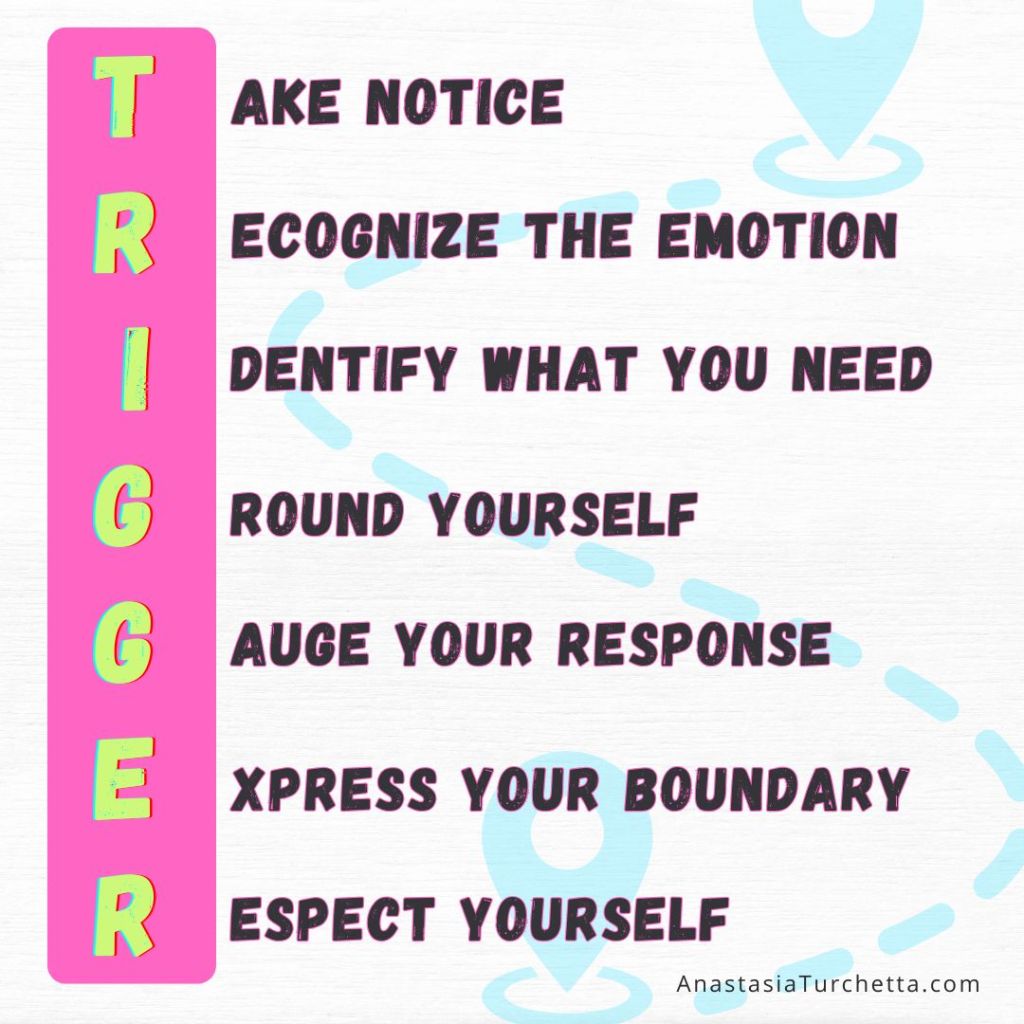
By keeping this method in mind, you can approach each moment of Thanksgiving with intention, clarity, and confidence.

1) Time Boundary: Deciding How Much Time You’ll Spend with Family or Friends

It’s easy to feel stuck between obligations to family and the desire to spend time with your chosen family or even justyourself. Setting a clear time boundary helps you honor both.

What to Say: “I’ll be here for the afternoon and dinner, and then we’re planning a quiet evening at home. Let’s make the most of our time together!”

What Not to Say: “I don’t want to be stuck here all day.”

2) Emotional Boundary: Managing Sensitive Family Dynamics and Unwanted Drama

Family gatherings can sometimes feel like stepping into a minefield of sensitive topics and clashing personalities. Protect your emotional energy by setting a tone of gratitude and redirecting conversations away from drama.

What to Say: “I’d love for today to be about gratitude and connection—let’s focus on the good things and leave the tough stuff for another time.”

What Not to Say: “Must we poke the bear on topics like that?”

3) Grief Boundary: Navigating Difficult Emotions During the Holidays

Holidays can bring bittersweet memories, especially when grief is part of the equation. Acknowledge your feelings and communicate your needs to make space for healing.

What to Say: “This time of year can be a mix of emotions for me. I’m so grateful to be here with you all, and I may need a few moments to myself if it feels overwhelming.”

What Not to Say: “I’m fine. I’ll stuff my emotions away today.”

4) Energy Boundary: Recognizing What—and Who—Drains You

Thanksgiving can be full of beautiful moments, but specific interactions can sap your energy. Take time to recharge when needed so you can stay fully present.

What to Say: “I’m stepping outside for a bit to get some air or taking the dog for a walk. I’ll be back shortly.”

What Not to Say: “I need a break from all of this drama.”

5) Expectation Boundary: Setting Limits on Holiday Obligations

Sometimes, holiday plans come with unspoken expectations. Whether it’s about attending every activity or following someone else’s schedule, a boundary lets you honor your own needs while still showing gratitude.

What to Say: “Thanks for organizing! I’m excited for [specific activity] and can stop by afterward, but not all night.”

What Not to Say: “I feel held hostage to your holiday schedule.”

The Road Ahead

Thanksgiving should be a time of gratitude and connection—not an emotional pile-up. When you take the wheel and map out your limits, you can enjoy the journey—bumps and all.

Navigating Wedding Season Stress-Free: A Guest’s Guide to Setting Healthy Boundaries

Wedding season is a time for joy and celebration, but it can quickly become overwhelming with a flood of invitations and commitments. To avoid saying yes to the stress, it’s crucial to set firm boundaries. Learn how to prioritize events, communicate your limits effectively, and find a balance that lets you enjoy the festivities without succumbing to stress.

Prioritizing Wedding Events

When your calendar is overflowing with wedding events, it’s essential to choose wisely which ones to attend. Consider your relationship with the couple and the location of the events. This is where you need to establish boundaries for your time, emotions, and energy.

Engagement parties can be fun, but attending every single one is unnecessary. It’s perfectly acceptable to skip them if your relationship with the couple is distant. For showers, focus on those of your closest friends and family. Sending a thoughtful gift and a note can be just as meaningful for others.

Ceremonies are often the main event, so prioritize attending those for couples you are close to. Receptions can also be significant, but if it’s not convenient or you don’t share a strong bond with the couple, it’s okay to decline. Cultural ceremonies are important too, but assess your ability to attend without feeling overwhelmed.

Managing Wedding Costs

Attending weddings can be expensive, adding stress if not managed properly. To handle this, create a detailed list of potential expenses, including shower and wedding gifts, wedding attire, travel accommodations, and pet or babysitter costs. Setting a budget early helps manage your finances and reduces stress. This planning will also guide you in deciding which events you can realistically attend, ensuring you stay within your financial limits.

Avoid saying “yes” to the stress!

Setting and Communicating Assertive Boundaries

Navigating wedding season requires setting and communicating clear boundaries, especially regarding overnight accommodations, relationships, time constraints, and responsibilities.

For instance, if you decide to stay at a hotel instead of with family for a wedding, this decision might cause some tension, but it’s necessary for your well-being.

What to Say: “For this trip, we’ve chosen to stay at a hotel to have our own space and recharge between events. We appreciate your understanding and look forward to celebrating with everyone soon.”

The “Wish Them Well” Boundary

A “wish them well” boundary allows you to gracefully disengage from guilt trips or difficult conversations.

What to Say: “It’s nice to see you; what a beautiful day or ceremony. I’m going to take my chances on the dance floor, or I’m on my way to catch up with [NAME . Enjoy the rest of your day!”

Keeping the focus on the couple helps maintain positive interactions and reminds everyone of the reason for the celebration. This can help you feel more engaged and less stressed.

Communicating Early

To manage expectations effectively, communicate your plans and limitations well in advance. Inform your hosts or the wedding party early on about your intentions to set expectations and reduce last-minute stress. This proactive approach can help you avoid unnecessary guilt trips and ensure a smoother wedding season experience.

What to Say: “Just a heads-up, here are our travel plans. Aside from the wedding day, are there any additional times or events for us to attend before we make plans on our own? We’re excited to celebrate with you.”

Wedding season should be a time of joy, not stress. By prioritizing events, managing your finances, and setting clear boundaries, you can enjoy the celebrations without feeling overwhelmed. Harness your time, emotions, and energy to fully enjoy the festivities on your terms. Create lasting memories and cherish the moments that matter most.

How Self-Care In Healthcare Isn’t As Hard As You Think | Employee Wellbeing

Did you know 3x as many Americans met the criteria for a depression diagnosis during the pandemic than before it? We are all in a relationship with stress and chaos. We spend approximately 1/3 of our time at work, and it may be helpful to consider these proven resources to help decrease stress, reduce workplace burnout, increase focus, compassion & happiness. This week I’ll share tips for you to share with your teams. *Special edition this week for IgniteDDS* 

Let’s look at what many of us may be experiencing daily. 

1. Isolation & Loneliness

2. Cancellation of events 

3. Supply chain anxiety

4. Travel restrictions 

5. Getting the virus or having family sick (high risk) 

6. Financial Stability 

7. Employment Uncertainty 

8. Domestic Violence 

9. Struggle with emotional and mental health, anxiety & depression 

10. Insomnia

It’s time to create a work culture that emphasizes; Connection, Compassion, and Communication. You help to develop work-life wellness. Forget balance. Balance is an even distribution of weight. Anything above sound balanced to you? Wellness is an actively pursued goal referring to being in good health! 

How do you begin? SELFcare in healthcare

1. Start a conversation with your team. 

2. Encourage vulnerability as a leader and lead with it. 

3. Listen with the purpose (everyone will have a different worry or symptom). Make sure that you are in a healthy, non-judgmental space to listen, not solve! You are not a therapist! 

4. Find and offer resources. Set small goals for mindfulness at work. Happify AND Headspace offer easy, time-efficient, & effective tasks for each member of your team. These tasks do not take up all of your free time at lunch. Accomplishing these goals may recharge you. 

Special note: These platforms may have free memberships during this pandemic. It’s worth it to check it out! 

I hope you found this information valuable!

Anastasia

Take What You Learn & Make A Difference With It

4 Acts Of Kindness That Are FREE + Good For Your Mental Health

How is kindness good for your mental health? It reduces stress and boosts self-esteem! This week I’ll share 4 acts of kindness, that are FREE and who doesn’t like FREE? The impact of these kindness tips will benefit you and those you share them with!

Here are 4 FREE acts of kindness you can do immediately!


1) IM or text a friend you have not contacted in a while. I like to say, I know this is a random text, yet I wanted you to know that you have been in my thoughts and I hope you are staying safe & healthy.

NEXT, amp up that text or IM and send a photo or memory you have and share that this was in your social media feed and it made you smile and hope it lightens up their day too.

Facebook made it easy for you! Go to the sidebar where it says explore. Look for the “memories” option and you are on the fast track to kindness.

FINALLY, send a music link that connects you to that friend, co-worker, etc. For example, every time I hear the song “The Safety Dance” I text or call my BFF since 2 nd grade to share that this song is playing and I’m thinking of her.

2) Give a genuine compliment to those in your space. Partner, child, co-worker, or employer.
My hubby and I share 2 things at the end of the day. First, we will share one thing that we loved about them that day (were they kind to someone in the grocery store, helped an older person, or had patience with you 🙂 ) and second, what they did that we are thankful for that day. It never gets old because each day is different!

You can write on a post-it note words of encouragement or empowerment to a co-worker or employer as we begin to re-enter our workplaces.

3) Join a LOCAL FB group and see how you can be helpful in your community. For example, we had a locally owned pet store that had an opportunity for customers to donate to a local dog food bank to help a local animal shelter.

Other examples are noticing if someone needs help shopping, dropping off or picking up mail, etc.

4) SMILE!! I’m not kidding! Be intentional and genuine! Smile at the grocery store cashier and thank them! Smile at people when you are walking your dog! Smiling is a healthy contagion! Smiling reduces stress and increases your happiness!

Let me know if these tips were helpful!

Till next time,

Take What You Learn & Make A Difference It!

How To Set Healthy Boundaries During COVID-19

Having healthy boundaries is a part of self-care! Where do you begin? This week, why healthy boundaries improve your relationships, and how to effectively communicate your needs to your partner, family, and friends. It’s about who you allow in your space! Space is your personal time, your emotional space, and where you give and spend your energy.

Sometimes the combination can feel quite crowded! That’s when my hubby, David, and I decided we would add a fun element to our communication when that happens. We say, “Get out of my nest”.

When your personal & emotional space feel crowded, I’ve found it helpful to say “Get out of my nest”.

anastasia

How are setting healthy boundaries helpful for you?

  1. You have defined your identity. You are confident. Not arrogant. Your confidence is going to work for you as others will now know what to expect from you. How refreshing is that?
  2. Healthy boundaries honor what you need. It is important to not judge other people’s choices or boundaries. Be kind & listen with an open mind.
  3. Determine the consequences for when someone crosses that line. Be committed to take action. What would that look like? Personally, I’ve chosen to unfriend individuals on social media, end friendships, relationships, and my work environment. It was not easy. When someone disrespects you more than once and you now know what to expect of them, ask yourself, “how will this impact my emotional & physical health if I continue to allow this.”?
  4. When you consistently follow 1-3 you will be respected. You don’t have to be loved or liked by everyone to be respected. 
  5. Ask your partner, friends, family & co-workers what their healthy boundaries may be or how you can best be helpful to them and …. listen.

How to communicate effectively is by using “I” statements.

Let’s say, you don’t want to talk about the news or COVID-19 anymore today. You may consider the following;

“It is not helpful to me to talk about COVID right now.” 

“It has been helpful for me to limit my news/media to 20 minutes a day. And I’m maxed out.”

“I am feeling overwhelmed today, may we change the topic? “

Here are some of my healthy boundary examples during COVID-19.

  1. TOPIC: Weight gain memes. 

ACTION: I scroll past them on social media without commenting because I’m hoping the algorithm will see that I don’t engage and find me other memes to interact with. So far, my theory has worked!

ACTION: If a weight gain meme is texted to me. I recognize that it is meant for humor & without a mean intention. Yet, I have set my boundary by texting back, “It is stressful for me to see memes that make fun of women gaining weight during COVID.”

2. TOPIC: Complaining or Boredom Texts / Posts

ACTION: I appreciate your view, however, I am focusing my energy on how I can be more thankful, happy for what I have right now. 

Both of those examples share what I will allow into my space without being unkind.

How do you have healthy boundary success? Get real with your feelings and what triggers your stress. Recognize who & what you will allow in your space to be your best.

Let me know if this has been helpful to you!

Anastasia

5 Self-care Apps For Mental Health During COVID-19 Crisis

This road trip takes us on a route for well-being during the COVID-19 crisis.

Dare to self-care using 5 awesome apps for mental health & motivation during a highly stressful time in your life!
Technology gifts us the ability to accomplish well-being!
I’ll share 5 apps that target mindfulness, resilience & empowerment!
FREE to download, some have extended their support or free trials during the COVID-19 crisis! What can you do if in-app purchasing, not an option? I’ve got you covered!
1) All 5 have a website with FREE blogs & resources
2) All 5 have a social media presence on Facebook, Twitter & LinkedIn. Take advantage of their messaging!

  1. Calm
  2. Talkspace
  3. SuperBetter
  4. Happify
  5. Headspace
5 Self-Care For Mental Health During COVID-19 Crisis